Belt alignment
Belt alignment means that the front and rear sprockets sit exactly in line: neither offset sideways (parallel alignment) nor turned towards each other (angular alignment). Both must be right for the belt to run quietly and last long.
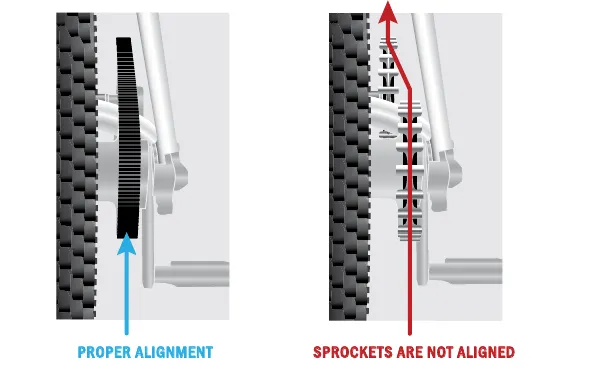
What misalignment causes
Section titled “What misalignment causes”- noise, usually the first symptom,
- early wear of the belt or the sprockets,
- belt walk-off: the belt migrates sideways towards a sprocket flange or off the sprocket.
Low tension can also cause noise, so tension and alignment have to be checked separately. Alignment must also hold while the tension is being adjusted.
Checking the belt line
Section titled “Checking the belt line”You need no tools for this check:
- Support the bike so that the rear wheel turns freely.
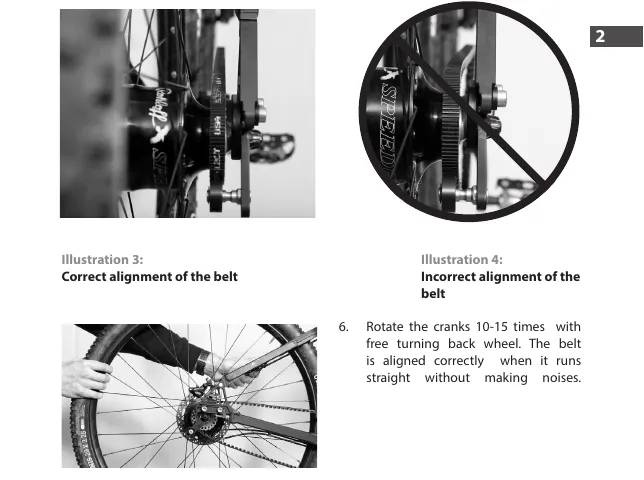
- Turn the cranks 10–15 times.
- Watch the belt where it runs onto and off both sprockets.
The belt is aligned correctly when it runs straight without making noise. If it drifts towards one flange, or makes a noise on every revolution, the alignment needs attention.
Repeat this check after every adjustment of the rear wheel or the belt tension.
What you can correct yourself
Section titled “What you can correct yourself”On a Booda the rear dropouts are vertical and cannot be adjusted to steer the belt. What you can check:
- The rear wheel sits fully and squarely in both dropouts.
- The axle nuts or the thru-axle are properly tightened.
- On Alfine models: the wheel is fitted as described in Rear wheel removal with Shimano Alfine.
- On Rohloff models: the wheel is fitted as described in Rohloff rear wheel removal and installation.
Then repeat the check above.
When to contact us
Section titled “When to contact us”If the belt still runs towards one flange with the wheel fully seated, contact us. On a Booda the belt line is set at the front: at the front sprocket and the bottom bracket, with shim rings where needed. On Rohloff hubs the belt line cannot be adjusted at the rear sprocket at all. This is workshop work, because the result has to be measured.
My belt runs off to one side of the sprocket. What should I do?
First check that the rear wheel sits fully and squarely in both dropouts and that the axle is tightened properly, then turn the cranks 10–15 times and watch the belt. If it still drifts towards one flange, contact us: the belt line on a Booda is corrected at the front sprocket and bottom bracket, which is workshop work.