Your belt drive at a glance
Every Booda Bike is driven by a Gates Carbon Drive belt instead of a chain. This page explains what the belt is, why it behaves differently from a chain, and what that means for you as a rider. The practical care steps follow in the next articles of this section.
The system in brief
Section titled “The system in brief”A Carbon Drive belt is a toothed polymer belt reinforced with carbon fibre tensile cords. It runs on purpose-made front and rear sprockets. The belt is a continuous loop: it has no master link and cannot be split. That is why every Booda frame has a splittable seat stay to let the belt in and out, and an eccentric bottom bracket to set the belt tension.
Why it behaves differently from a chain
Section titled “Why it behaves differently from a chain”- No lubrication. There are no pins and bushings to oil, so there is no oil film to attract grit and no grease on your trousers or luggage.
- No corrosion. The belt body is polymer and the cords are carbon, so rain, road salt and winter storage do not attack the belt itself.
- Practically no stretch. Carbon cords barely lengthen under load, so a belt does not “wear long” the way a chain does. Tension that was set correctly stays broadly correct.
- Quiet running. There is no chain clatter.
- Lower weight than an equivalent chain drivetrain.
The trade-off: the belt needs correct tension and alignment, and it must be handled carefully. Our frames are built for this, and the following articles show what you can check yourself.
How the belt is built
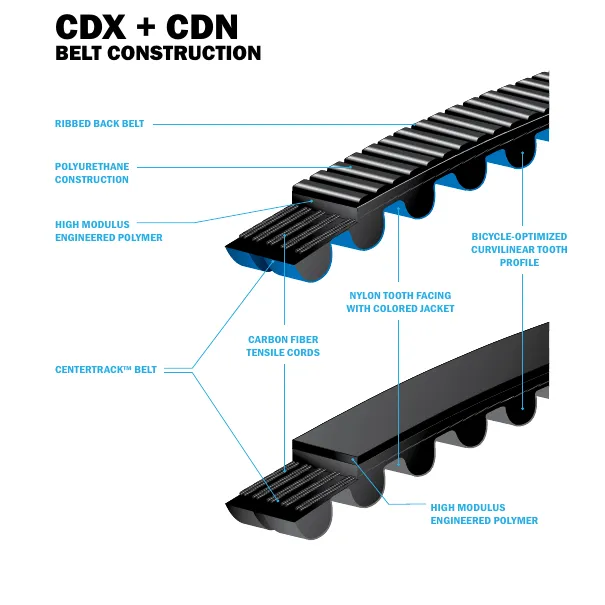
Section titled “How the belt is built”A Carbon Drive belt is a composite, and each layer has a job:
- Carbon fibre tensile cords run the length of the belt and carry the load.
- A polymer body holds the cords and forms the teeth.
- A nylon tooth facing adds strength and wear resistance where the belt engages the sprocket. On CDX belts this jacket is blue.
- A ribbed back reduces bending resistance, which makes the drive more efficient.
- The CenterTrack groove runs down the middle of the tooth face. A matching ridge on the sprocket keeps the belt in line, and dirt, mud and snow are pushed out sideways.
The carbon cords take very high pulling force, but they are sensitive to bending, twisting, crushing and impact. Damage of this kind may not be visible from the outside, and a damaged belt can fail suddenly. That single fact is behind all the handling rules in Handling the belt without damaging it.
Which hub drives the belt on your Booda
Section titled “Which hub drives the belt on your Booda”| Hub | Booda models |
|---|---|
| Rohloff SPEEDHUB 500/14 | Pulse – Rohloff, Alpine – Rohloff, Alpine E-14 versions |
| Shimano Alfine 8 or 11 | Banker (Alfine 8), Hiker (Alfine 8 or 11) |
| 3x3 hub with electric shifting | Alpine 3x3, Pulse 3x3 |
| Single-speed hub | Pilot, Atlas, Sander, Astro, Player S |
The hub decides the target belt tension (see Belt tension). Booda builds its Rohloff models without a snubber: see Why a Rohloff Booda has no snubber.
Belt lines
Section titled “Belt lines”Gates makes several belt lines. All of them use the CenterTrack design described above; they differ in material, intended use and expected life. Gates states the expected life only as a comparison with a chain, and the real figure depends on how and where the bike is ridden.
| Line | Expected life (Gates estimate) | Approved temperature range |
|---|---|---|
| CDX | about 3 × a chain | −53 °C to +85 °C |
| CDC | about 2–3 × a chain | −53 °C to +85 °C |
| CDN | about 1–2 × a chain | −20 °C to +60 °C |
When a belt or sprocket needs replacing, replace it with the same line and size. Belt lengths are fixed, and the eccentric bottom bracket only has a small adjustment range. If you want to change the line or the gear ratio, ask us first.
Clothing and impact
Section titled “Clothing and impact”A belt drive is free of grease, but it is still a drive system. Gates warns that it can catch trousers, skirts or loose clothing, and recommends a belt guard. Keep hands and clothing away from the belt while it is moving.
Where rocks or logs could hit the belt, Gates strongly recommends a bash guard to protect it.
What is Gates Carbon Drive and how is it different from a chain?
It is a toothed belt reinforced with carbon cords that runs on matching front and rear sprockets instead of a chain. It needs no oil, does not rust and hardly stretches, so it runs clean and quiet. In return it needs correct tension and alignment, and careful handling: the cords are strong in pull but can be damaged by kinking or twisting.
Can I ride my belt drive in frost and winter conditions?
Cold itself is rarely the limit: CDX and CDC belts are rated from −53 °C to +85 °C, CDN belts from −20 °C to +60 °C. What Gates warns against is snow, ice and clay-based mud packing into the sprocket teeth, which can push the belt off or make it skip. Rinse road salt off with water after winter rides.