Belt and sprocket wear
Gates belts and sprockets last a long time, but they do wear. Gates distinguishes three reasons for replacement, and each has its own rule.
1. Replacement after damage
Section titled “1. Replacement after damage”A belt must always be replaced if it has been damaged by improper handling (crimping, twisting, back-bending, prying or rolling it on) or by an external event, for example when a stone, a root or a piece of clothing was caught and pulled between the belt and a sprocket.
Such events can damage the carbon cords inside the belt even when nothing is visible from the outside. Gates’ guidance is to replace the belt if it has been damaged this way, or if you only suspect it might have been, because it can break suddenly while you ride.
The same applies after the belt has skipped (ratcheted) under load: replace it before it is used again.
2. Replacement because of wear: the belt
Section titled “2. Replacement because of wear: the belt”Inspect the belt regularly. Replace it when you see any of these:
- cracks in the belt body,
- a missing tooth, or teeth that are not symmetrical (for example a “shark tooth” profile),
- fabric worn through, so that the polymer body shows,
- exposed carbon cords.
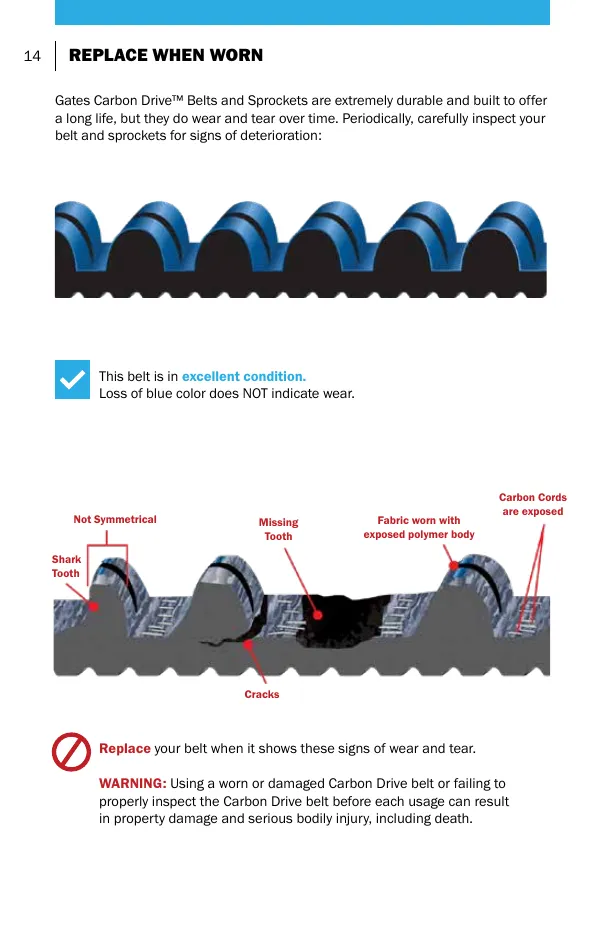
Not wear: on a new belt the blue layer on the inside wears off quickly. It is a release agent from manufacturing, has no function, and its loss says nothing about the condition of the belt.
3. Replacement because of wear: the sprockets
Section titled “3. Replacement because of wear: the sprockets”Sprockets wear too. Replace a sprocket when you see:
- a shark-tooth profile: teeth ground to a point instead of a symmetrical shape,
- cracks in the teeth,
- a noticeable groove or step where the belt runs. The belt is narrower than the sprocket, so wear eventually leaves a visible step.
Booda sprockets use the CenterTrack design. Compare yours with the lower half of the picture below.
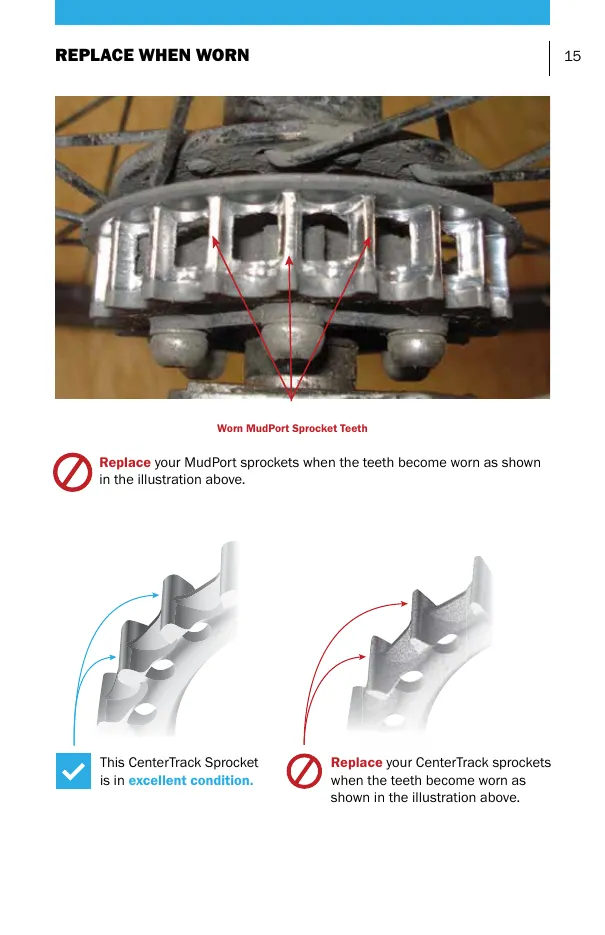
A sprocket must also be replaced after damage: hitting the front sprocket hard on a rock or a tree trunk can bend it, and stones caught between belt and sprocket can break teeth.
When the belt keeps skipping
Section titled “When the belt keeps skipping”Gates gives a test that links the two: if the belt keeps skipping even though the tension is at or above the recommended value, do not add more tension: inspect the sprockets for wear. Look for sharp edges, pointed teeth and cracks.
Replace belt and sprockets together
Section titled “Replace belt and sprockets together”A new belt on a worn sprocket wears out very quickly, because the worn tooth profile no longer matches the belt. If the sprockets are worn, replace them together with the belt.
How long does a belt last?
Section titled “How long does a belt last?”Gates does not publish a replacement interval, because it depends on conditions: mud, grit and rough riding shorten the life of any drive. Correct tension and alignment matter more than distance ridden. Regular inspection is what tells you when to replace.
Replacement parts and warranty
Section titled “Replacement parts and warranty”Replace belts and sprockets with the same line and size; tell us your model and we will supply the right parts. How the belt is fitted on a Booda frame is described in Fitting a new belt.
Belts and sprockets wear with use. Whether a particular failure is covered is described in What does the warranty cover?
How do I know when a belt or sprocket is worn out?
Replace the belt if it has cracks, a missing or uneven tooth, fabric worn through to the body, or exposed carbon cords. Replace a sprocket with pointed, cracked or grooved teeth. A belt that was kinked, twisted or caught a stone may be damaged inside without visible signs, and should be replaced too.