Belt care and inspection
One of the biggest advantages of a Gates Carbon Drive belt is how little care it needs compared with a chain: no oil, no degreasing, no stained trousers. What it does need is a rinse when it is dirty, and a regular look at the belt and sprockets.
The short version
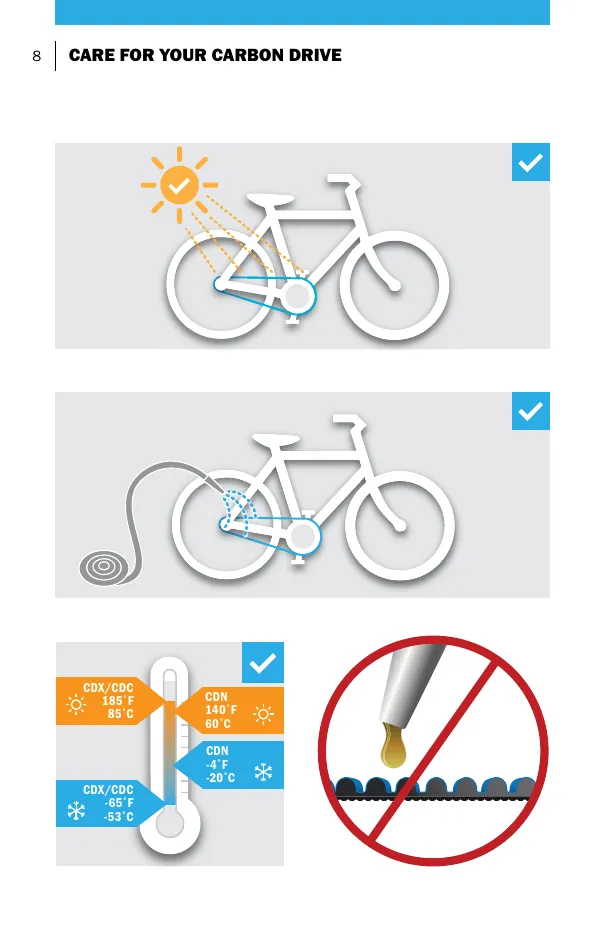
Section titled “The short version”- No lubricant of any kind ever goes on the belt or sprockets.
- When the belt is muddy, sandy or salty, rinse it with water.
- Use the clean, wet belt as a chance to inspect it.
Cleaning
Section titled “Cleaning”Mud, sand or fine dust packed into the belt or sprockets can cause creaking and faster wear.
- Rinse with clean water. A garden hose is ideal. Do not use a pressure washer: the jet can drive water into the bearings.
- For stubborn dirt, scrub the belt teeth and the gaps between the sprocket teeth with a soft brush or sponge and mild soapy water, then rinse.
- After salty or gritty rides, such as winter roads with salt, sand or coastal spray, rinse straight away. This prevents the grinding and squeaking that build up otherwise.
If the belt squeaks when dry
Section titled “If the belt squeaks when dry”On dry, dusty or salted roads the belt may start to squeak or groan faintly. This comes from the dryness of the belt material and is not a defect.
Our recommendation: spray the toothed (inner) side of the belt with a silicone spray made for Gates belts, such as Gates Belt Care. Silicone repels water and dirt and quietens the belt.
If the squeak comes back soon after, the cause is more likely tension, alignment or dirt. Work through Belt noise.
What to check on the belt
Section titled “What to check on the belt”Look at the belt regularly, ideally while it is clean and wet. Look for:
- cuts or cracks in the belt body,
- missing teeth or teeth that are not symmetrical,
- frayed edges,
- fabric worn through so the polymer body shows underneath,
- exposed carbon cords,
- stones or debris trapped between the belt teeth,
- the belt rubbing against the frame, a sprocket flange or a guard,
- the belt not running in the middle of the sprockets,
- the belt slipping or skipping under load.
On a new belt the blue layer on the inside wears off quickly. This is a release agent from manufacturing, not wear.
What each finding means, and when to replace the belt, is in Belt and sprocket wear.
What to check on the sprockets and crank
Section titled “What to check on the sprockets and crank”- The sprockets are clean, and the teeth are not ground to a point, cracked or grooved.
- The crank turns smoothly.
- The crank has no side play, and does not grind, knock or look loose.
If the crank has play or knocks, do not ride until the bike has been checked.
Tension and alignment
Section titled “Tension and alignment”A belt that is too loose can skip over the sprocket teeth, which damages the carbon cords. A belt that is too tight wears the bearings of the hub and the bottom bracket. How to check and adjust it: Belt tension.
After removing or adjusting the rear wheel, make sure the wheel is fully seated and straight, and that the belt runs in the middle of the sprockets. A belt that constantly rubs against a sprocket flange wears its edge early. See Belt alignment.
When to stop riding
Section titled “When to stop riding”Stop riding and contact us if:
- the belt is cut, cracked, frayed or has a damaged tooth,
- the belt skips over the sprocket teeth, even once,
- the crank is loose or has play,
- the rear wheel is not secure in the frame,
- the hub skips, misses shifts or makes unusual noises.
Clothing
Section titled “Clothing”The belt drive is free of grease, but it can still catch trousers, skirts or loose clothing. Keep hands and clothing away from the belt while it is moving.
How do I clean a belt drive, and can I lubricate it?
Rinse the belt and sprockets with clean water; for stubborn dirt use a soft brush or sponge, then rinse. Never use chain oil, grease, WD-40 or a pressure washer. After salty or gritty rides, a rinse matters more than anything else.
The blue colour is wearing off my new belt. Is it worn?
No. The blue layer on the inside of a new belt is a release agent from manufacturing that lets the belt out of its mould. It wears off quickly, has no function, and its loss says nothing about the condition of the belt. Judge wear by cracks, damaged teeth, worn-through fabric or exposed cords instead.