Handling the belt without damaging it
Once it is fitted correctly, a Gates Carbon Drive belt needs almost no attention: no lubrication and, with correct tension, no frequent re-tensioning. The belt is vulnerable not in riding but in handling: when it is off the bike, being fitted, stored or carried.
Why handling matters
Section titled “Why handling matters”The belt’s strength comes from carbon fibre tensile cords. They:
- absorb very high pulling force, which is what they are made for, and
- are sensitive to bending, shearing, crushing and impact.
Even though the cords are sheathed in polymer, they need the same care as any other carbon product. Bending or twisting the belt can damage the cords inside it.
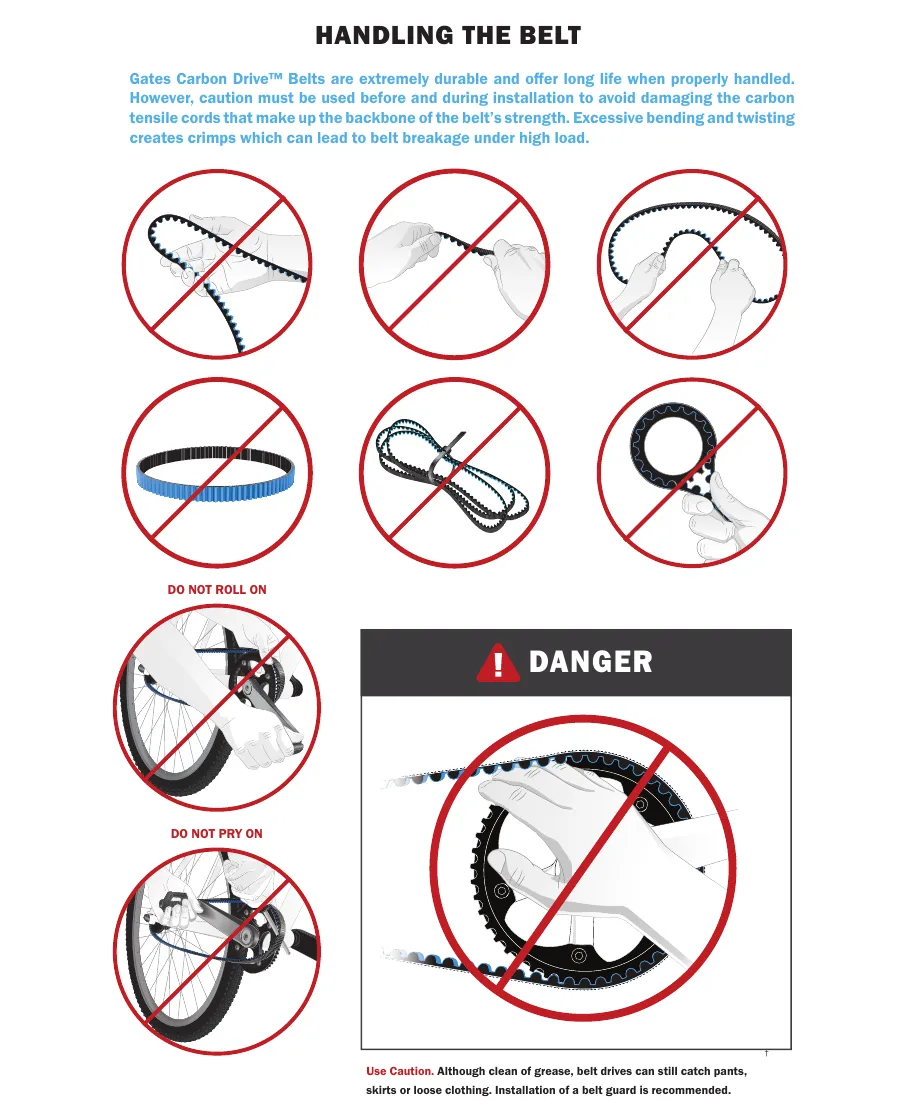
Never do this with a belt
Section titled “Never do this with a belt”Gates lists these explicitly. Do not:
- crimp or kink the belt,
- twist the belt,
- back-bend (bend it against its normal direction),
- turn it inside out,
- bundle it tightly,
- zip-tie it,
- roll it on to a sprocket,
- pry it on to a sprocket,
- use it as a strap wrench,
- use it as a chain whip to hold a sprocket.
Never do this while fitting the belt
Section titled “Never do this while fitting the belt”The Gates manuals show these as examples of improper mounting:
- running the belt beside the sprocket instead of on it,
- securing the belt with zip ties,
- clamping the belt in the dropout,
- clamping the belt behind the crank,
- stepping on the belt,
- clamping the belt to the frame,
- using pliers on the belt.
Uncoiling a new belt
Section titled “Uncoiling a new belt”Belts are supplied coiled, and uncoiling them the wrong way can damage them permanently. Never pull the belt open violently, and never bend it to a smaller diameter than it takes on its own.
- Hold the belt at chest height in front of you, gripping the outer coils with both hands.
- Move your hands apart slowly until the belt uncoils by itself.
- The belt is now uncoiled correctly.
You let the belt open; you do not force it open.
Storing and carrying a spare belt
Section titled “Storing and carrying a spare belt”A belt can stay loosely coiled for a long time. It does not tolerate sharp kinks, tight bundling or anything that forces a bend into a small radius. Do not zip-tie a spare belt into a tight loop for transport.
Conditions to avoid when riding
Section titled “Conditions to avoid when riding”Gates warns that snow and ice can clog the sprocket teeth. This can push the belt off the sprocket, or lift it so that it skips over the teeth. Both make the drive less safe, so avoid riding in snow and ice where you can. Clay-based mud has the same effect.
For cleaning, see Belt care and inspection.
Can I coil a spare belt tightly or cable-tie it for transport?
Not tightly, and never with a cable tie pulled down on it. Crimping, back-bending, twisting and zip-tying all damage the carbon cords inside. Keep a spare belt in a loose, natural coil. A belt that has been mishandled must be replaced, even if it looks fine.
Why can a belt take hard pedalling but be ruined by bending it by hand?
The carbon cords running the length of the belt are extremely strong in pure tension, which is the load pedalling applies. They are not made for bending, shear or impact, so kinking, back-bending or dropping the belt can break cords inside it, with no visible damage on the outside.